If you’re stuck choosing between Shorts and long videos, you’re not alone. I hear this question constantly. And honestly, it’s easy to get confused because Shorts can explode overnight… while long-form can feel slow and kind of “quiet” at first.
But here’s the thing most people miss: Shorts and long videos don’t compete the way you think they do. They behave like two different platforms living inside the same app. Different viewer mood. Different session style. Different expectations. And yep—different money outcomes.
So, which one should you focus on in 2026? Personally, I think the better question is: what job do you want each format to do for your channel? Because once you assign roles, the strategy gets way clearer (and less stressful).
Let’s break it down like a real creator would.
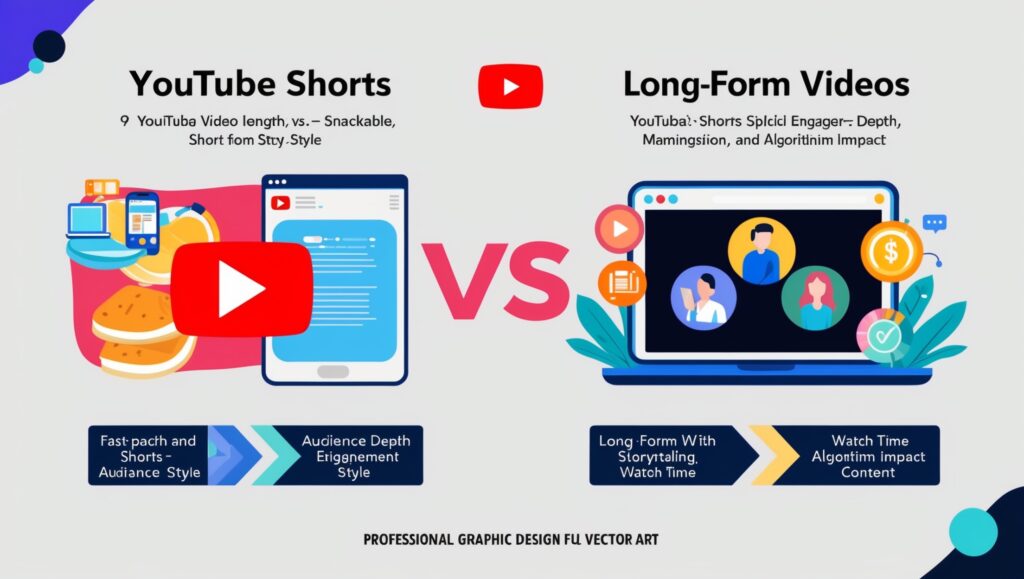
1) Views & reach: Shorts usually win (and it’s not close)
Shorts are built for fast discovery. YouTube can test your Short with new viewers quickly, because the “risk” is low. It’s a 15–60 second watch (or up to a few minutes now), not a 12-minute commitment.
That’s why you’ll see small channels pull off wild numbers on Shorts. Sometimes it’s 5,000 views in an hour. Sometimes it’s 500,000 in a weekend. And you’re sitting there like… “How is this even real?”
It’s real. Shorts are just a distribution machine.
Where Shorts shine:
- Top-of-funnel exposure (new people finding you)
- Testing ideas fast (hooks, topics, jokes, angles)
- Staying visible even when you can’t upload a long video that week
And YouTube has been actively investing in Shorts for years, including expanding what counts as a Short (for example, YouTube announced longer Shorts, up to 3 minutes, depending on the rules at the time you upload). That matters because it gives creators more room to add a mini-story instead of a “blink and it’s over” clip.
Source: YouTube official announcements about Shorts updates and formats. YouTube Blog (Shorts product updates)
The catch (and it’s a big one):
- Shorts views are often less “sticky”. People binge the feed, laugh, swipe, and forget.
- Subscriber conversion can be lower than you expect.
- A viral Short doesn’t automatically mean your long videos will take off.
So yes—Shorts can win on reach. But reach alone isn’t the whole game.
2) Monetization: long-form still tends to be the main moneymaker
If your goal includes real income—not just numbers—long-form usually carries the channel.
Why? A few reasons:
Mid-roll ads (long videos have more ad inventory)
Traditionally, videos over a certain length (commonly 8+ minutes) can include mid-roll ads, which can raise total revenue per video when used responsibly. The exact settings depend on your channel and YouTube’s current policies, but the general principle stays the same: more time = more chances to monetize.
Source: YouTube Help (ads, mid-rolls, and monetization basics). YouTube Help Center
Long-form RPM often beats Shorts RPM
Shorts monetization works differently. YouTube uses a Shorts ad revenue pool and shares revenue with creators (after certain adjustments like music licensing), rather than paying per individual pre-roll the way long videos typically do. YouTube’s documented Shorts revenue share to creators is 45% (with YouTube keeping 55%), under the Shorts revenue sharing model for eligible creators.
Source: YouTube Help (Shorts revenue sharing). YouTube Help Center
For long-form watch-page ads, the classic split is 55% to creators for ads shown on their videos (with YouTube keeping 45%), though your actual earnings depend on CPM, RPM, audience, ad types, and so on.
Source: YouTube Help (revenue share basics for YPP). YouTube Help Center
More “real business” options
Long videos are simply better for:
- Sponsorships (brands want integration time)
- Affiliate links (viewers need context + intent)
- Digital products (courses, templates, packs)
- Memberships (community building happens deeper)
- Email list growth (people actually click when they trust you)
My honest take: Shorts can make you famous-ish. Long-form makes you stable. Not always, but often.
3) Watch time & “session value”: long-form has a natural advantage
A lot of creators oversimplify the algorithm as “watch time, watch time, watch time.” YouTube’s public messaging is more about viewer satisfaction—getting people to watch what they enjoy and keep coming back. Watch time matters, but it’s a proxy signal, not the only one.
Source: YouTube on recommendation goals and satisfaction signals. YouTube Creator Academy / Help
Still, practically speaking, long videos can create:
- Longer sessions
- More suggested-video momentum
- Better “next video” flow
- More returning viewers (if your content hits)
Shorts get high completion rates, which is great. But the total minutes per view are tiny. So one person watching one 12-minute video can equal a lot of Shorts views in pure watch time.
And here’s the part people don’t like hearing: watch time that turns into loyalty is the real cheat code. That’s what long-form is good at.
4) Engagement & community: long-form builds the relationship faster
Shorts engagement is real, but it’s “fast food engagement.” Quick likes, quick comments, quick follows.
Long videos give you room to:
- Tell stories
- Explain your opinions
- Teach something properly
- Show personality (without rushing)
- Create inside jokes and recurring segments
And that’s how community forms. People don’t just watch. They recognize you. They trust you.
But will it really matter for most users? If you’re doing YouTube casually, maybe not. If you’re trying to build a brand you can monetize for years, it matters a lot.
If you want to understand how long-form content compares with Shorts, read our detailed breakdown on YouTube Shorts vs Long Videos: What Actually Works in 2026.
5) The winning combo: the Shorts → Long “traffic funnel”
This is where the strategy gets fun.
A Short can be the “spark.” The long video is the “campfire.”
Here’s a simple funnel that works in almost any niche:
- Make a Short that highlights one punchy moment
- A surprising result
- A mistake people make
- A quick before/after
- A “don’t do this” warning
- Point to the full video
- “Full breakdown is on my channel”
- “I explain the setup step-by-step in my latest video”
- “Watch the full guide—link is on my page”
- Make the long video actually worth clicking
- Clear promise
- Strong intro
- No rambling for 90 seconds (this kills retention)
You can link long videos through:
- Related video links where available
- Playlists
- Pinned comments (where applicable)
- Your channel homepage layout (seriously underrated)
One small reality check: Shorts viewers don’t always convert. Sometimes they just want more Shorts. That’s okay. Your job is to give them a bridge to long-form repeatedly, in a natural way.
And repetition helps. Yes, it feels awkward. But repetition helps. Say it in different words. Mention the long video twice. Say it early, then again near the end. Not spammy—just clear.
6) So… what should you focus on in 2026?
If you’re a small channel (starting or under ~10–20k subs)
Shorts can be a smart growth lever, because they let you:
- Learn faster
- Get feedback faster
- Build confidence on camera faster
- Discover what topics “hit” faster
A practical balance I like:
- 60–80% Shorts
- 20–40% long-form
Not because long-form doesn’t matter, but because long-form takes time. Shorts keep you shipping while you build your skills.
If you’re an established channel
Long-form usually becomes the backbone:
- It’s where the money is (ads + sponsors + products)
- It’s where the brand becomes clear
- It’s where returning viewers happen
Then Shorts become support content:
- Highlights
- Teasers
- Quick takes
- Clips from the long video (edited properly, not lazy crops)
Niche matters (a lot)
Some niches are naturally long-form:
- Tutorials
- Business breakdowns
- Tech deep dives
- Finance explainers
- Documentaries / storytelling
Other niches can thrive on Shorts:
- Comedy
- Trends
- Reactions
- Quick DIY
- “Did you know?” facts (if done well)
Honestly, most people won’t notice the nuance here until they look at analytics. But the pattern is usually obvious once you do.
7) A simple weekly plan that doesn’t burn you out
If you want a realistic workflow, here are two options.
Plan A: Long-form led (best for income + loyalty)
- 1 long video per week (or every 2 weeks)
- 3–7 Shorts per week, all pointing back to the long video
How to make it easier: record one long session, then cut 5–10 Shorts from it.
Plan B: Shorts led (best for fast growth + testing)
- 4–7 Shorts per week (topic testing + hooks)
- 2 long videos per month (based on what performed best in Shorts)
Personally, I like Plan B when you’re still figuring out your niche voice. It’s just less pressure.
8) Mistakes I see creators make (and how to avoid them)
Mistake 1: Posting random Shorts with no “channel promise”
If your Shorts are all over the place, you’ll get views… but you won’t build a recognizable channel.
Fix: pick 2–4 repeating content pillars.
Mistake 2: Treating long videos like “optional extras”
If you want serious revenue, long-form can’t be an afterthought.
Fix: commit to a schedule you can keep. Even 2 long videos a month can work if they’re strong.
Mistake 3: Making Shorts that don’t match your long-form topic
If your Short is comedy but your long video is a serious tutorial, the funnel breaks.
Fix: align the vibe and audience intent.
9) What to track in analytics (the stuff that actually tells the truth)
You don’t need to obsess over every metric. Track a few:
For long-form:
- CTR (click-through rate): is your title/thumb working?
- Average view duration: are people staying?
- Retention graph: where do they leave?
- Traffic sources: browse, suggested, search (each needs different strategy)
For Shorts:
- Viewed vs swiped away: your hook strength
- Average percentage viewed: pacing and payoff
- Subscribers gained per Short: quality of audience match
For money:
- RPM (revenue per 1,000 views) by format
- Top earning videos (then make more like them)
Source: YouTube Analytics documentation and Creator resources. YouTube Help Center
Bottom line
If you’re asking “Shorts or long videos?” the real answer is: use both, but on purpose.
- Shorts = discovery, speed, testing, attention
- Long videos = depth, trust, watch time, revenue
The creators who win in 2026 usually do this:
They let Shorts bring new people in, then they use long-form to turn those people into actual fans (and customers, and members, and repeat viewers).
And yes, it takes consistency. But it doesn’t have to be complicated.
If you want, I can also:
- write a matching YouTube description + tags + 3 pinned comment options, or
- turn this into a script (hook, pattern interrupts, CTAs) for a video version.